REA Coding-Agent Case: A Video-Editor Prototype
Quick answer: Use the documented REA setup command, then treat the Kdenlive-inspired editor as a prototype. Playback, effects and pane resizing still had problems in the recording. This is not evidence that REA recreated a production editor.
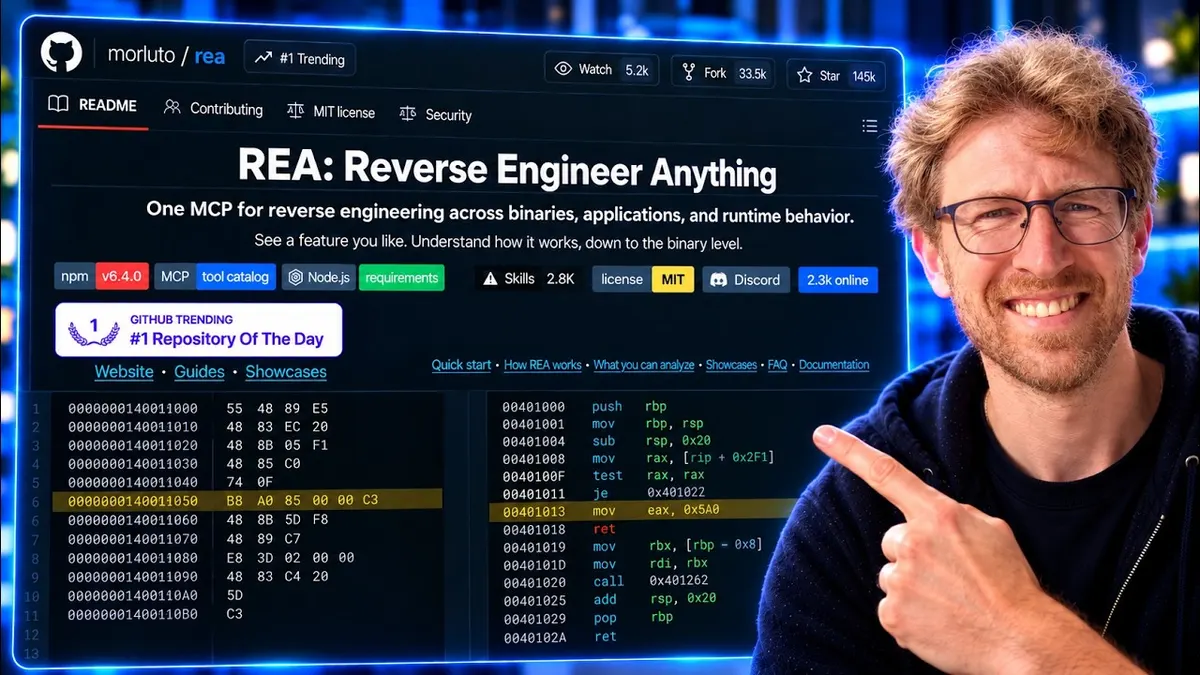
REA helps a coding agent inspect how software works. In the AAS recording, Mike connects the skill to several coding harnesses and asks Claude Code for a Kdenlive-inspired video editor. The resulting app has recognizable controls and a working timeline interaction, but effects, playback and pane resizing still have problems.
This is a prototype case study, not evidence that REA recreated a production editor or made every feature functional.
Install for the agent you intend to use
The official REA setup page currently provides npx rea-agents@latest setup, followed by approval of the setup plan and an agent restart. The recording copies a one-line setup command, selects coding harnesses and restarts to make the integration available.
This article did not run that command. Review a dependency’s current installation behavior and use a development environment you control. Connecting a skill should not grant permission to inspect software or data you do not have rights to access.
Ask about a feature before requesting a whole application
The official site describes a narrower loop: give the agent a program and question, inspect the program, then explain or rebuild a feature. That is a more testable starting point than “recreate the entire editor.”
Mike deliberately tries the larger request. The transcript says the build runs for several hours and produces a project called Cutline. It does not preserve a complete specification or source-code history for that build.
For a bounded evaluation, choose one permitted feature and define how you will compare its behavior. Separate a functional rule from a similar-looking interface.
Test a real editing action
The recorded prototype opens a new project, accepts media and lets Mike drag it into a timeline. He splits a clip and adjusts the timeline view. Those are concrete interactions worth checking in a prototype.
The same sequence also reveals failures. Playback behaves unexpectedly, effects appear nonfunctional and a draggable pane behaves badly. Those problems belong in the result. Do not crop the acceptance test down to the controls that happen to work.
Write a repair request that names the failure
Mike asks Claude to fix the application’s bugs, including sliders. The recording does not establish that the repairs finish successfully. A request to fix something is not proof it was fixed.
A useful follow-up brief would identify the action, expected result, actual result and smallest reproduction. That structure is editorial advice, not a hidden prompt recovered from the video. Recheck the same interaction after the agent changes the code.
Keep rights and evidence separate from the tool’s reach
An inspection tool’s ability to read software does not decide what you are allowed to copy, redistribute or brand as your own. Kdenlive is described as open source in the recording, but a redistribution plan still needs the applicable source license and asset rights reviewed. No legal clearance is claimed here.
Likewise, a visually similar menu is not evidence of a correct render pipeline, stable export or broad format support. The spoken source does not demonstrate a completed export test.
Watch the walkthrough
FAQ
Did the prototype replace Kdenlive?
No. It remained incomplete and buggy in important editing interactions.
Does the exact setup command come from the transcript?
The complete spelling above comes from the current official REA page, not from reconstructing machine-transcribed speech.
What should I try next?
One permitted feature with a small acceptance test, followed by a reviewed change. Keep export and publication separate from the prototype experiment.
You may also like

Build the next one with AI Income Lab
Step-by-step courses, reusable templates, and a community that answers when you get stuck.
Members get the Claude Code & Skills and Codex Tutorials & Courses lessons.
- Courses for builds like this one
- Copy-ready templates
- Ask questions while you build
- Weekly coaching on VIP


