OpenDesign (Open Design) on Linux: Source Setup and Slides
Quick answer: Follow the recorded Linux source setup, make one first design, then export a standalone HTML deck. Local agents, BYOK keys and hosted credits are billed separately, so a free desktop app is not free inference.
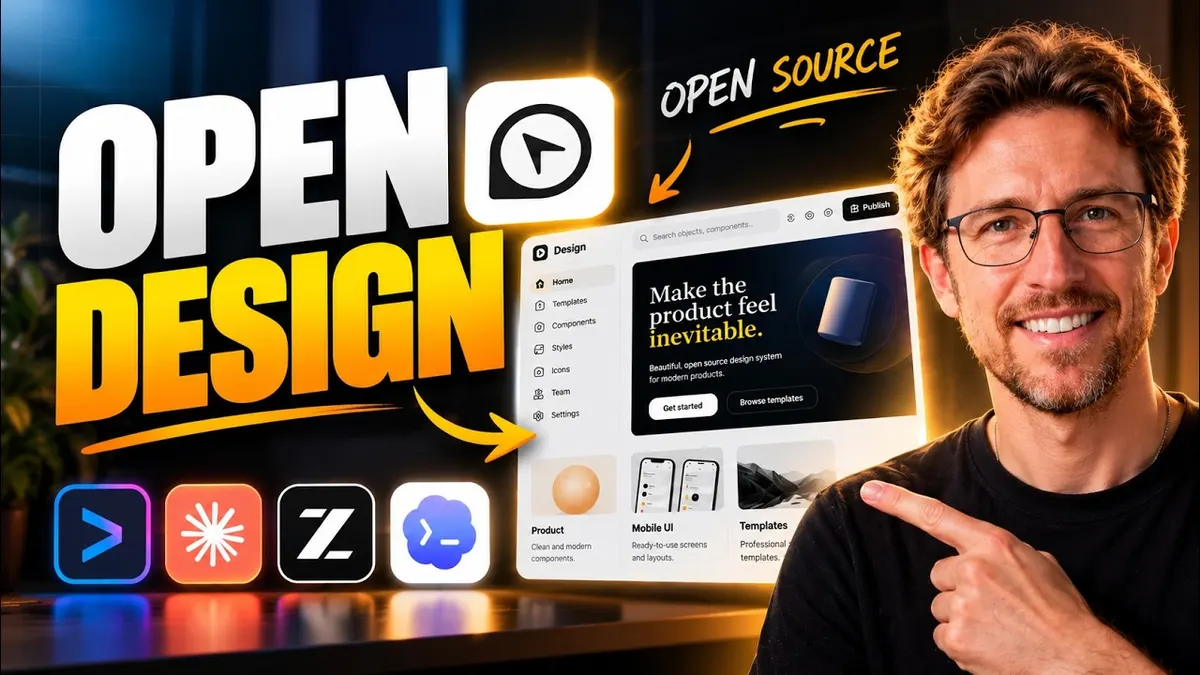
OpenDesign, also written Open Design, is a workspace around design-generating agents and models. The AAS recording follows a Linux source build, a small animation-style design test and a slide deck exported as standalone HTML. The useful result is a previewable artifact, not proof that generation is unlimited or that a prototype is production-ready.
The current official site distinguishes local coding agents, your own model keys and hosted OpenDesign Cloud. Local agents retain their own usage charges, your model provider bills BYOK usage, and hosted models use the relevant plan credits. This is why “free desktop app” should not be interpreted as “free inference.”
Choose the setup path you are actually using
In the recording, the download options cover macOS and Windows. Mike uses the official source repository because he is on Linux. The current product FAQ still says Linux can run from source rather than from a Linux download-page build.
Use the repository linked by the official site for current build instructions. The spoken transcript mentions missing node modules and Corepack, but it does not contain every command required for a clean Linux installation. Do not reconstruct a shell script from those fragments.
Resolve the observed dependency problem
Mike encounters a missing Corepack command and installs it through the package manager available on his machine. The project then starts locally. That is an environment-specific repair, not a reason to install an extra package manager on every Linux system.
Keep the original dependency error and compare it with the current repository requirements. Check the final application launch rather than treating a completed package installation as the finish line.
Pick an agent or model before generating
The recorded session signs in to a hosted account, inspects available models and notes the option to supply provider API keys. The current documentation also supports an account-free local-agent path. Those are different routes, so instructions written from the recording should not make account creation a universal prerequisite.
For your first test, specify a small artifact with a clear audience and message. Mike uses a 20-second paper-cutout story, then opens its preview and generated HTML. That lets him inspect a concrete output rather than assuming a completed generation message means it matches the brief.
Build a deck from checked source material
Mike next asks for a slide deck about an AI consulting workflow and provides a reference video. The deck appears after another run and he reviews its slides. He then exports standalone HTML and opens it separately.
The transcript says he hopes the tool can pull the reference transcript. It does not establish that extraction succeeded or that every slide accurately reflects that source. Before using a deck, compare its factual claims with the source yourself. A finished visual design can still contain invented claims or missing context.
Export and inspect the independent file
The current product documentation lists HTML, PDF and PNG exports, with editable PowerPoint for decks. Only HTML export is part of this recorded walkthrough. Do not describe other exports as tested here.
Open the exported artifact outside the working preview. Check navigation, text, sources and any required assets. That is the acceptance step, not evidence that the deck has already been published or shared with a team.
Troubleshooting and limits
A source-build error is a dependency problem until shown otherwise. A generation failure may instead involve the selected provider, account entitlement or balance. Keep those causes separate. The recording consumes credits even while describing the experience as free, so no fixed cost or permanent allowance is promised.
For a reusable content brief and human review checklist, see the AAS content workflow guide.
Watch the walkthrough
FAQ
Does Linux have the same download as Windows?
The current official FAQ says Linux uses a source build.
Did the reference video definitely become the deck’s factual source?
That extraction is not established by the spoken recording. Verify every claim before presenting it.
You may also like

Build the next one with AI Income Lab
Step-by-step courses, reusable templates, and a community that answers when you get stuck.
Members get the Claude Code & Skills and Codex Tutorials & Courses lessons.
- Courses for builds like this one
- Copy-ready templates
- Ask questions while you build
- Weekly coaching on VIP


