How to choose an AI model for a task
Quick answer: choose a model by testing it on representative examples of your actual task. Compare correct results, time, cost, privacy requirements and how safely it handles unclear input. A leaderboard or launch demo can help create a shortlist, but it cannot select a model for your own workflow.
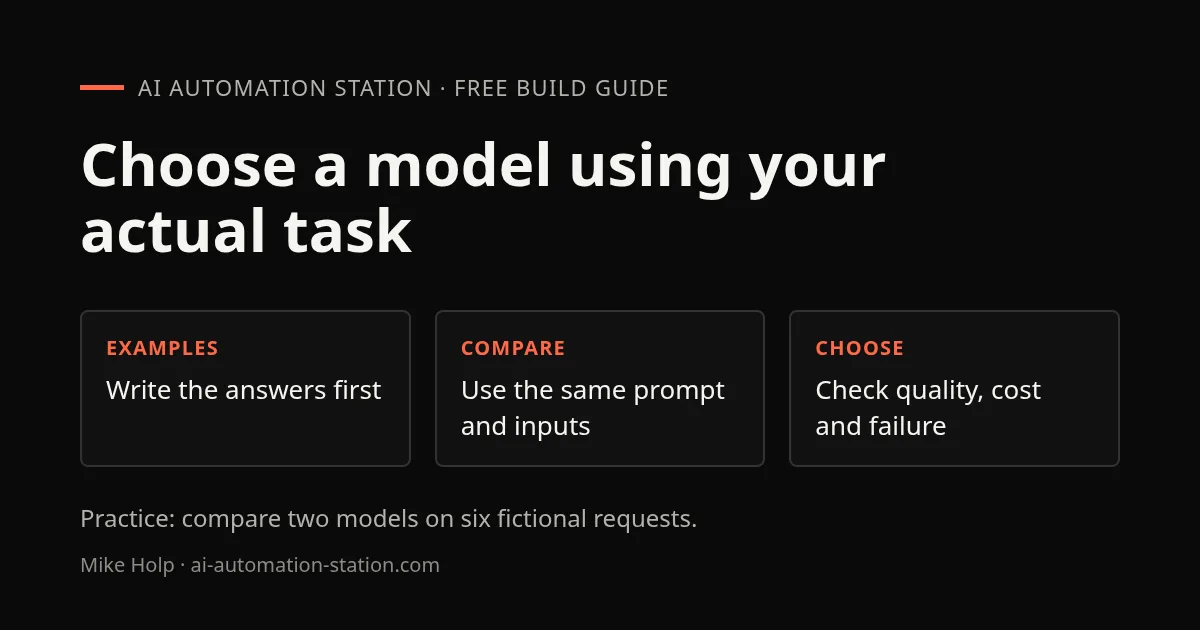
Define the job and its failure cost
Write down the input, output format, success criteria and unacceptable errors. Decide whether the model drafts text, extracts fields, writes code or recommends an action. Keep high-impact decisions with a qualified person. If a simple rule or search is sufficient, test that before adding a model.
Build a small test set
Collect examples that reflect ordinary, edge and ambiguous cases. Remove private or sensitive data unless you have permission and a suitable provider agreement. Record the expected answer and the reason it is correct. Keep the same examples for every model so the comparison is fair.
Measure useful outcomes
- Quality: does the output meet the task's criteria?
- Reliability: does it keep the required format across different examples?
- Latency: can users wait this long?
- Total cost: include input, output, retries and any platform fees.
- Privacy: does the provider's data handling fit the information you process?
- Recovery: can the workflow stop safely when the model is uncertain or a tool fails?
Use ordinary code to validate fixed requirements such as JSON shape, allowed values or arithmetic. Ask a person to review subjective output. Track model name, version, settings and date because provider behavior and pricing can change.
For an executable example of checking outcomes before a provider is involved, run this site's local API mock: it checks expected HTTP 401, 404 and 200 responses. Those checks validate the mock's request handling; they do not compare model quality or establish provider reliability.
Run the comparison
- Choose two or three candidate models with different cost or capability profiles.
- Run the same examples and settings through each.
- Score each output against your written criteria, without relying on the model's self-rating.
- Repeat a small sample to see whether results vary.
- Pick the least costly option that meets the quality and safety bar.
Do not route every task to the most capable model by default. A smaller model can handle a narrow, low-risk classification if it passes the same checks. Escalate ambiguous cases rather than silently accepting weak output.
Recheck after changes
Repeat your test set when you change model version, prompt, tools, provider or data. Keep a fallback and a manual path. If a workflow affects customers, money, access or publication, log the decision and require a human approval before the external action.
For current Claude model details, see Claude model comparisons. For connecting providers, read the OpenRouter setup guide or 9Router guide.
A failed connection is a separate result from a weak model answer. The DeepSeek Harness first test records setup errors and demo limits, while the Meta Muse Code setup walkthrough separates an API failure from a working CLI route. Keep those environment failures out of a model-quality score until you have a usable response to evaluate.
Practice: compare two models on six requests
Use fictional requests and a classification task that you can judge. The labels are brief, review, and needs_review. Write the expected result before running either model.
| Input | Expected label |
|---|---|
| Draft a project brief for a calendar app | brief |
| Write a brief for a booking site | brief |
| Review the wording of my draft homepage | review |
| Check the clarity of this draft paragraph | review |
| Help with that thing | needs_review |
| empty input | needs_review |
Give each model the same instruction: return one label per input; do not invent missing context. Keep the prompt and settings unchanged and save the outputs. Record whether each label is correct, whether the required format is followed, and whether the model tries to take action beyond classification.
Repeat the comparison to expose inconsistent answers. If you use an API, record the billed usage and retries from the provider's own reporting; if you use a chat subscription, report that cost separately rather than estimating an API price. Timing from one run is an observation, not a general speed ranking.
A useful result is a six-row comparison with the actual outputs and reasons for failures. Reject a model that invents details for the ambiguous or empty case even if its other answers sound better. Expand the test set with real, permitted examples before using it for a business decision. These acceptance criteria are not a published benchmark or a claim that either model has passed.
FAQ
Should I choose the model with the highest public benchmark score?
Use benchmarks as a starting point, then compare candidates on your own task and acceptance criteria. The right format, failure handling, privacy requirements and total cost can matter more than an overall score.
How many examples do I need before going live?
The six fictional examples are a learning exercise, not a production validation set. Add representative ordinary, ambiguous and failure cases from your actual workload, then review the errors before increasing exposure.
Sources
Build the next one with AI Income Lab
Step-by-step courses, reusable templates, and a community that answers when you get stuck.
Members get the Claude Code & Skills and Codex Tutorials & Courses lessons.
- Courses for builds like this one
- Copy-ready templates
- Ask questions while you build
- Weekly coaching on VIP


