Claude Opus vs Sonnet vs Haiku vs Fable: which model to use
Quick answer: Use Claude Opus 5.5 for most coding and agent work: it is Anthropic’s recommended starting point and costs $4 / $20 per million input / output tokens. Use Sonnet 5.5 ($2 / $10) when speed and cost matter more, for well-scoped fixes and frequent coding turns. Use Haiku 5.5 (from $0.10 / $0.50) for high-volume jobs such as classification, extraction and sub-agents. Keep Fable 5.1 ($10 / $50) for the hardest long-running tasks, after Opus 5.5 at a higher effort has fallen short.
This guide compares the four current Claude models on price, speed, effort settings and what each is for, then shows how to switch between them in Claude Code. The prices and specs come from Anthropic’s models overview, checked November 3, 2026. The hands-on notes come from my launch videos for each model, which I recorded between June and October 2026 while using them on my own projects.
The search people type most is “Claude Opus vs Sonnet”, so that comparison gets its own section. If you only want the table, jump to the comparison table.
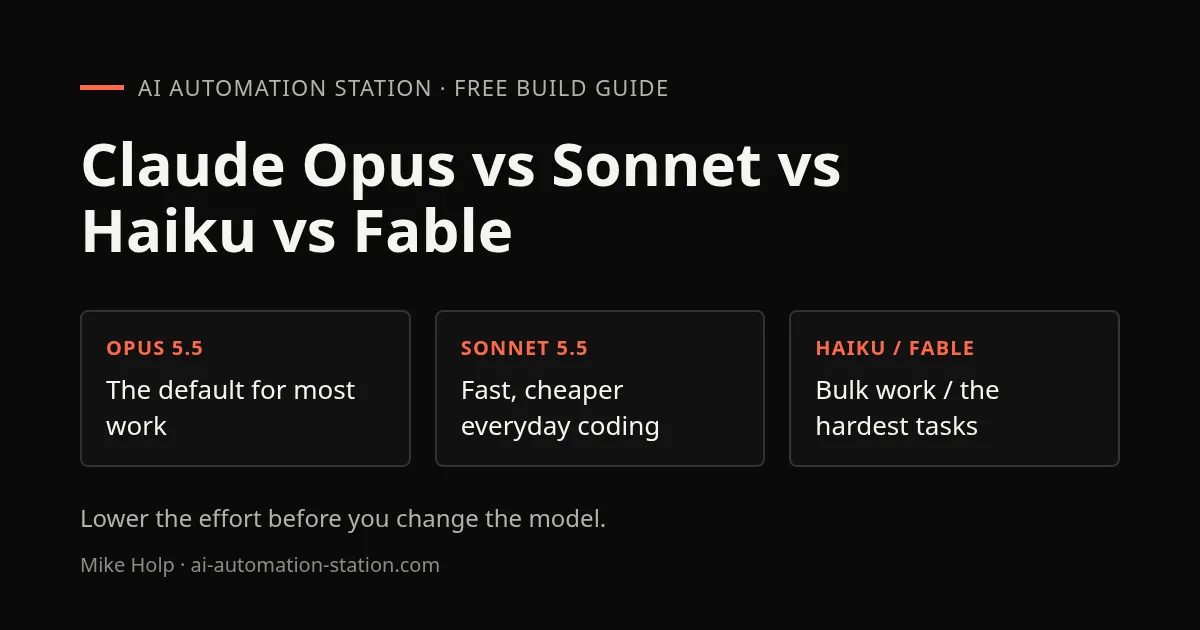
The four Claude models side by side
| Model | Input / output per 1M tokens | Speed | Default effort | Anthropic’s description |
|---|---|---|---|---|
| Fable 5.1 | $10 / $50 | Slower | high | Demanding reasoning and long-horizon agentic work |
| Opus 5.5 | $4 / $20 | Moderate | medium | Long-running agentic coding and knowledge work |
| Sonnet 5.5 | $2 / $10 | Fast | high | The best combination of speed and intelligence |
| Haiku 5.5 | From $0.10 / $0.50 | Fastest | medium | High-volume, latency-sensitive tasks such as classification, extraction and routing |
All four have a 1 million token context window, 128K tokens of maximum output, image input and tool use. Haiku’s “from” price covers prompts up to 100K tokens; longer prompts cost $0.50 / $2.50. Every model is 50% cheaper through the Batch API, and cached input is much cheaper than fresh input: 2.5% of the base price on Fable 5.1, 5% on Opus 5.5 and Sonnet 5.5, and 10% on the others.
Default effort matters more than it looks. Opus 5.5 and Haiku 5.5 default to medium; Fable 5.1 and Sonnet 5.5 default to high. In the Sonnet 5.5 launch, Anthropic said Claude Code and the Claude apps start Sonnet at medium while the API starts it at high. If two models seem far apart on a task, check that you are comparing them at the same effort.
Claude Opus vs Sonnet: which one for coding?
Opus 5.5 costs twice as much per token as Sonnet 5.5 ($4 / $20 against $2 / $10). Anthropic’s overview puts Opus forward as the default for most workloads and describes Sonnet as the best balance of speed and intelligence.
In practice the gap is smaller than the price suggests. In my Sonnet 5.5 video I went through Anthropic’s launch numbers: Sonnet 5.5 edged out Opus 5.5 on Terminal-Bench 4.0, was roughly level on Cursor Bench and on knowledge work, and Opus stayed ahead on Frontier Code. Anthropic also said Sonnet 5.5 runs more than 30% faster than Sonnet 5 and uses fewer tokens per task at the same price.
- Pick Sonnet 5.5 for well-scoped bug fixes, many short coding turns, first drafts, slides and anything you run often. It is fast enough that you notice it in the Claude desktop app.
- Pick Opus 5.5 for long agentic sessions, large refactors, audits across a whole codebase, and work where one wrong step costs you more than the token bill.
- Test both on one real task from your own project, at the same effort, before settling. Benchmarks are an average; your codebase is not.
When I tried Opus 5.5 on launch week, I ran a design audit of my homepage in a cloud session in the Claude desktop app, had it write an implementation plan in plan mode, and then let it apply the fixes. The audit and plan used about $5 of a $100 cloud-session credit that Anthropic had added to my account that week.
Claude Sonnet vs Haiku
Haiku 5.5 costs a twentieth of Sonnet 5.5 per token ($0.10 / $0.50 against $2 / $10, for prompts under 100K tokens). Anthropic’s launch post said it costs about 75% less to run than Haiku 4.5 on average and is aimed at fast, repetitive work: customer support, browser use, and acting as a sub-agent for Opus 5.5 or Sonnet 5.5 on coding work.
The trade is capability. In the launch benchmarks I covered in my Haiku 5.5 video, Haiku scored 39% on agentic coding against 70% for Sonnet 5.5, and 72% on computer use against slightly more for Sonnet. Use Haiku where the task is narrow and checkable: sorting tickets, pulling fields out of documents, routing requests, summarising short pages. Use Sonnet when the model has to plan or write code you will ship.
When Claude Fable 5.1 is worth it
Fable 5.1 is Anthropic’s most capable widely released model and the most expensive, at $10 / $50 per million tokens. Anthropic’s own guidance is to use it for demanding reasoning and long-horizon agentic work, or when your tests on Opus 5.5 at a higher effort still fall short.
Three things to know before you pay for it:
- It burns through limits fast. With Fable 5 on high effort in Claude Code, I used 95% of my Pro plan’s five-hour allowance in about twelve minutes while running a security audit. Fable 5.1 is cheaper per task than Fable 5, but it is still the top price tier.
- Plan access has changed more than once. Fable 5 launched on June 9, 2026, was suspended outside the US on June 12 by a US export control directive, and returned globally in early July with classifiers that send some requests to an older model. When I tested Fable 5.1 on September 3, Claude Code on my Pro plan asked me to buy usage credits to use it. Check the model picker on your own plan before you plan work around it.
- Opus 5.5 closes most of the gap. Anthropic launched Opus 5.5 as performing at the level of Fable 5.1 on most work at a lower cost. Try Opus 5.5 at high or xhigh effort first.
Pick a Claude model by task
| Task | Start with | Move to |
|---|---|---|
| Everyday coding, small fixes, quick questions | Sonnet 5.5 | Opus 5.5 if it keeps missing |
| Long agent sessions, refactors, codebase audits | Opus 5.5 | Fable 5.1 if Opus at high effort falls short |
| Classification, extraction, routing, sub-agents | Haiku 5.5 | Sonnet 5.5 if accuracy is too low |
| Writing, slides, documents | Sonnet 5.5 | Opus 5.5 for long, structured work |
| Security reviews and high-risk changes | Opus 5.5 | Fable 5.1, with a human review either way |
Two habits matter more than the model choice. First, lower the effort before you change model: medium on Opus 5.5 is often enough for routine work, and it saves the most. Second, measure the cost of a finished task, not one request. A cheaper model that needs three retries is not cheaper.
Switch models and effort in Claude Code
- In a Claude Code session, type
/modeland pick the model. Models your plan does not include will ask you to add usage credits. - Type
/effortand choose low, medium, high, xhigh or max. Higher effort means more thinking and more usage. - Press
Shift+Tabto cycle into plan mode for larger tasks, so the model writes a plan you approve before it edits files. - Check
/usageas you go. The five-hour and weekly limits are shared across models, and the larger models use them faster.
A pattern that works for me: write the detailed prompt with Sonnet in the Claude desktop app, then run the build in Claude Code on Opus at high effort in plan mode, and drop back to a cheaper model for small follow-ups like updating CLAUDE.md. If you are new to Claude Code, start with the Claude Code beginner guide. If you hit your limits often, the Codex vs Claude Code guide shows how I route work between two subscriptions.
You can also reach Claude models through other tools. OpenRouter gives one key for many providers, and 9Router puts several accounts behind one local endpoint with fallbacks.
Older Claude models you may still see
Anthropic still serves the previous generation, so you may see them in model pickers and older tutorials, including some of mine:
- Fable 5 ($10 / $50): replaced by Fable 5.1 at the same per-token price.
- Opus 5 ($5 / $25): replaced by Opus 5.5, which is cheaper. My Opus 5 video covers its launch.
- Sonnet 5 ($2 / $10): replaced by Sonnet 5.5 at the same price. Sonnet 5.5 still falls back to Sonnet 5 for some higher-risk security tasks.
- Opus 4.8 and earlier: Fable 5 used Opus 4.8 as its fallback after the July relaunch.
Unless you depend on a specific older behaviour, move to the 5.5 or 5.1 models: they cost the same or less.
FAQ
Which Claude model should I use?
Start with Claude Opus 5.5 for most coding and agent work, which is what Anthropic recommends. Use Sonnet 5.5 when you want faster, cheaper turns, Haiku 5.5 for high-volume simple tasks, and Fable 5.1 only for the hardest long-running work.
Is Claude Opus better than Sonnet?
Opus 5.5 is stronger on long, complex agentic work and costs twice as much per token. Sonnet 5.5 is close on many coding benchmarks and is faster, so it is the better value for well-scoped fixes and frequent coding turns.
How much do Claude models cost?
As of November 3, 2026, per million input and output tokens: Fable 5.1 $10 and $50, Opus 5.5 $4 and $20, Sonnet 5.5 $2 and $10, and Haiku 5.5 from $0.10 and $0.50. Batch requests are 50% off.
What is the difference between Claude Fable and Opus?
Fable 5.1 is the most capable model for demanding reasoning and long-horizon agent work, at $10 and $50 per million tokens. Opus 5.5 costs $4 and $20 and performs at a similar level on most work, so try it first.
How do I change the model in Claude Code?
Type /model in a Claude Code session and pick the model, then type /effort to set the effort level. Models your plan does not include ask you to add usage credits.
What is Claude Haiku good for?
Haiku 5.5 suits narrow, high-volume tasks: classification, extraction, routing, customer support and acting as a sub-agent for Opus or Sonnet. It is the fastest and cheapest current Claude model.
Sources
- Anthropic: models overview and comparison
- Anthropic: pricing, batch and caching rates
- Anthropic: choosing a model
- Anthropic: the effort parameter
Build the next one with AI Income Lab
Step-by-step courses, reusable templates, and a community that answers when you get stuck.
- Courses for builds like this one
- Copy-ready templates
- Ask questions while you build
- Weekly coaching on VIP


