AI Visibility Tracker: SaaS Build Log
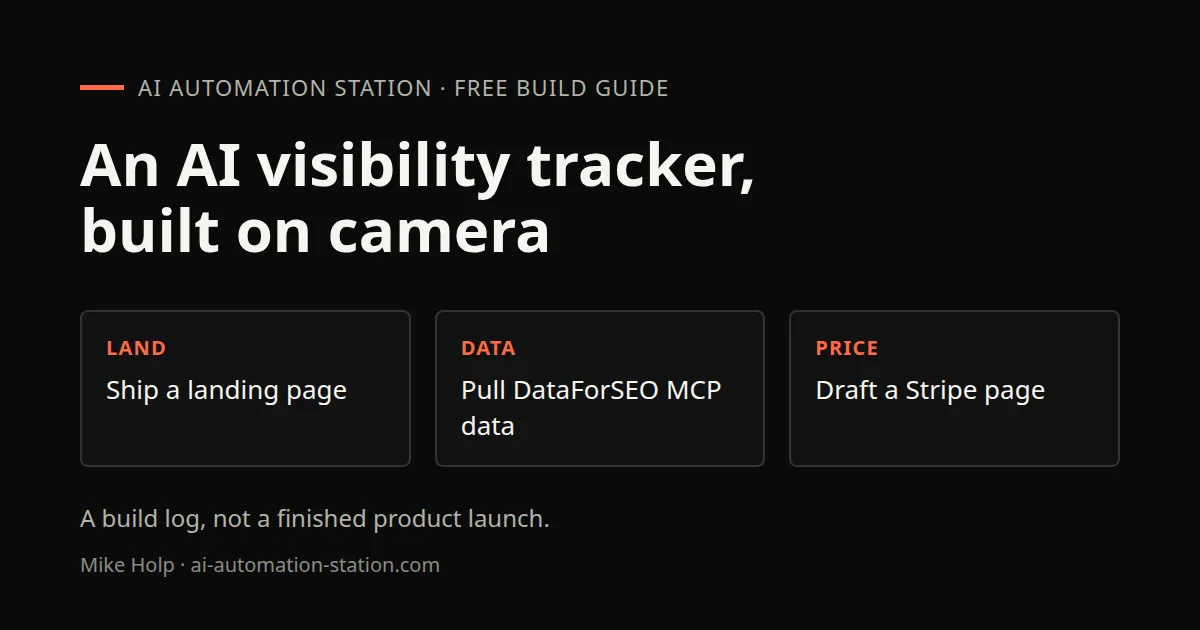
Quick answer: This is a 6 July 2026 build log of Beacon, an MVP AI visibility tracker. The recording shows a landing page, Clerk login, a dashboard of metrics that were not interactive yet, DataForSEO live data, GEO bot files and a Stripe pricing page draft. It did not show a launched product or revenue.
MCP install steps belong on DataForSEO MCP: build an AI SEO agent in Claude Code. This page only notes that the recording ran that install, then went back to the tracker build. For a shipped visibility product the presenter prefers, see Trakkr and Codex: AI Visibility, Crawlers and Visits.
What this recording shows
The working name on camera is Beacon, kept until a better name turns up. The stack in the recording is OpenCode with GLM 5.2 and DeepSeek V4 Pro, plus Codex and Claude Code. The goal stated on camera is a tracker that shows where a site ranks across ChatGPT, Claude and Gemini. After about two to three hours of work, most dashboard controls were still not interactive. Treat every screen below as an MVP snapshot from 6 July 2026, not as a live product.
1. Landing page, Clerk login and dashboard
The recording opens on a simple landing page, then sign-in or account creation with Clerk, already wired into the app. The Beacon dashboard lists overview, visibility score, presence, average position, dimensions, win rate and trend. The presenter says most of those are not interactable yet.
A later localhost check tries to connect an organization through Clerk and fails. The recording says that would need a new push to Vercel. No production login is shown working.
2. GLM 5.2 vs DeepSeek V4 Pro costs
OpenCode usage shown early in the recording:
- About $10 spent on GLM 5.2 and $2.50 on DeepSeek V4 Pro.
- Monthly usage at 37% on the Go plan named as $10 per month.
On the OpenCode data site in that session, DeepSeek V4 Pro was ranked number two and GLM 5.2 number four. Token rates shown there were $0.43 per million input and $0.87 per million output for DeepSeek V4 Pro, against $1.40 per million input and $4.40 per million output for GLM 5.2, described on camera as roughly five times more expensive. The rule used in the recording is GLM 5.2 for complex tasks and DeepSeek V4 Pro otherwise. Go plan signup itself is on OpenCode Go: pricing, models, limits and setup, not repeated here.
Later in the same recording, GLM 5.2 spend is $12, monthly usage 58%, and the 5-hour Go limit is hit, with a reset in about four hours. An award in the dashboard is applied and 5-hour usage falls to 60% so the pricing-page task can finish. Those numbers are a single session, not a benchmark.
3. Competitor-feature prompts
The product the presenter wants to match is spoken as Tracker and tracker.ai, priced in the recording at $100 per month after a rise from $70. The written guide for that workflow on this site is Trakkr and Codex: AI Visibility, Crawlers and Visits. In Claude desktop, the recording says it asked for a detailed prompt to build an AI visibility tool in Claude Code that matches much of the same functionality and design. The generated prompt is pasted into OpenCode or Claude Code. A follow-up asks the model to read the docs and write another detailed prompt for Codex to build core features. The caption track does not include those generated prompts, so they are not copied here.
Spoken instruction from the Claude desktop step:
create a detailed prompt to build an AI visibility tool in Claude code which matches much of the same functionality and design of tracker.aiTo keep a paused agent moving, the recording uses:
continue4. Live data from DataForSEO MCP
The build then starts pulling live data from DataForSEO instead of mock data. The recording mentions a free account with about a dollar of test credits, an MCP that coding harnesses can use, and the AI optimization data API for prompts, AI keyword data and LLM responses. The install command is run on screen and is not spoken. Do not copy an invented command from this page. Use DataForSEO MCP: build an AI SEO agent in Claude Code for credentials, the add command and a query you can check.
The stated product loop is: the user connects a domain, the app shows where that domain ranks across LLMs, then a skill from skills.sh writes a blog article that answers a prompt using output from ChatGPT, Gemini or Claude. Tube Analytics is cited as the presenter's own example, with 500 blog articles and a crawler view of which AI bots visit. Prisma is named as the backend still to wire, also available through Vercel. That is planned work in the recording, not a finished data path.
5. GEO files, workflows and integrations
The recording lists robots.txt, llms.txt and ai.txt as core files so LLMs can crawl the site, plus a Trello-style board for actions that are done or in progress, reports for progress, and integrations named as Google Analytics, Slack, Notion, GitHub and Cloudflare. Those screens are described as still in progress. For other AI-visibility audits, see VisiScan AI Visibility Audit, Rank Prompt AI Search Visibility and OpenSEO review: setup, data costs and practical limits. A related OpenCode skill run on visiscan.app is OpenCode SEO Audit Skills: Site Checks and Files.
Credit balancing across tools in the same session: Opus 4.8 in Claude Code because Fable 5 was burning weekly credits, with a reset in about five days, plus Codex and OpenCode for the rest of the work.
6. Stripe pricing page draft
Stripe billing is not in the app at the start of this chapter. The presenter tells GLM 5.2 in OpenCode to build the pricing page and connect it to Stripe, aiming for a three-tier layout like Tracker. The agent reports Stripe already installed, then builds a billing page. After the 5-hour limit and the award reset, it reports billing done and gates green, then checks that pages render on the dev server.
What the draft showed on that localhost:
- A 7-day free trial.
- Growth at $99 per month.
- Scale at $299 per month.
- A features list and an FAQ section.
- A notice that Stripe is not configured yet.
The recording asks viewers to comment if they would test a platform like this when it is actually available in production. That is the end of the build log. This page does not treat Beacon as launched or as earning money.
Watch the walkthrough

FAQ
Did this SaaS launch or make money?
No. The 6 July 2026 recording is an MVP build log. Clerk login on localhost was not working, Stripe was not configured, and the close asked for comments from people who might test it later in production.
Should I install DataForSEO MCP from this page?
No. The recording runs an install that is already on screen, but it does not speak the command. Use the DataForSEO MCP guide for credentials, the add command and a checkable query.
What did the Stripe pricing page show?
A draft with a 7-day free trial, a Growth plan at $99 per month and a Scale plan at $299 per month. The recording said Stripe was not configured yet.
What GLM 5.2 and DeepSeek V4 Pro costs did the recording show?
Early in the session OpenCode showed about $10 spent on GLM 5.2 and $2.50 on DeepSeek V4 Pro, with monthly usage at 37%. Token rates shown on the OpenCode data site were $0.43 per million input and $0.87 per million output for DeepSeek V4 Pro, against $1.40 input and $4.40 output for GLM 5.2. Later, GLM 5.2 spend was $12, monthly usage 58%, and a 5-hour Go limit had been hit.
Sources
- Video: I Built an AI Search Visibility Tracker for ChatGPT, Claude & Gemini (6 July 2026)
- DataForSEO: https://dataforseo.com/
- Clerk: https://clerk.com
- Stripe: https://stripe.com
- OpenCode: https://opencode.ai
You may also like

Build the next one with AI Income Lab
Step-by-step courses, reusable templates, and a community that answers when you get stuck.
Members get the Claude Code & Skills and Codex Tutorials & Courses lessons.
- Courses for builds like this one
- Copy-ready templates
- Ask questions while you build
- Weekly coaching on VIP


