AI Model News: Kimi K3, GLM 5.2, Claude Fable 5, Gemini 3
Quick answer
These are release-day notes, so treat benchmark claims as the vendors’ and other creators’ results, not mine. GLM 5.2 and Kimi K3 are selectable in OpenCode on the Go plan with the models command, and I could not run GLM 5.2 myself because I had hit my limit. Kimi K3 was cheaper per token than Claude Fable 5 but, in another creator’s test, used far more tokens and ran longer, and my audit hit a priority-queue limit. Fable 5’s return came with new classifiers that route some coding to Opus 4.8. Gemini 3 in Google AI Studio rebuilt a landing page and a logo mockup app quickly.
This guide merges four short news videos into one page. I made them on or just after each release, so the numbers are a snapshot and may be out of date. When I say a model “beat” another, that is what a benchmark page or another creator reported. I did not reproduce it, except where I say I ran a task. The OpenCode link on this site is an affiliate link. To pick a model for your own work, use the model-choice exercise instead of trusting launch-day charts.
1. GLM 5.2 from Z.AI (June 2026)
Benchmark pages I read put GLM 5.2 on max mode ahead of Claude Opus 4.7 and 4.8 and close to Fable 5 at a fraction of the price, rank 10 on Code Arena and first on a single-round HTML web design leaderboard. It is described as a 744 billion parameter model with 40 billion active and a 1 million token context window, and can run locally through Unsloth or Ollama. In OpenCode on the Go plan, run the models command and pick it; it also appears in the free desktop app. I had hit my Go usage limit, so the side-by-side demos against Opus 4.8 were another creator’s, not mine.
2. Claude Fable 5’s return (July 2026)
I read Anthropic’s announcement and press coverage the day before the model returned. It said Fable 5 was being redeployed after talks with the US government, with new classifiers to block more cybersecurity misuse, so some routine coding and debugging would fall back to Opus 4.8. Access was being restored in the UK, EU and India on the Claude platform, Claude.ai and Claude Code, with cloud providers to follow. Some paid plans included it for up to 50 percent of weekly limits through July 7. It had not come back when I recorded, so I did not test it. I compared its roughly 10 and 50 dollars per million input and output tokens with GLM 5.2 at about a tenth of that.
3. Kimi K3 from Moonshot AI (July 2026)
On launch day Arena and Moonshot’s blog put K3 near the top: a 17-place jump from K2.6 on front-end design and high ranks on coding benchmarks such as DeepSWE, Terminal Bench 2.1 and Frontier SWE. Its price was 3 dollars per million input tokens and 15 per million output, against 50 for Fable 5 output. In another creator’s test, though, it used about 21 million tokens against 3.5 million and ran three to four times longer. I selected it in OpenCode Go, noted that Moonshot had paused new subscriptions because of demand and ran a site audit, which hit a rate limit pointing to a paid priority queue. Signing in to the Kimi Code CLI failed with a membership error. I spent about 20 cents of my 10-dollar plan.
4. Gemini 3 in Google AI Studio (November 2025)
Google’s release post was dated November 18, 2025 and its charts showed Gemini 3 ahead of Claude Sonnet 4.5 and GPT 5.1 on tests such as Humanity’s Last Exam. In AI Studio I asked it to rebuild my landing page with a new colour scheme, used a mockup app that puts an uploaded logo on products and signage (I used a client’s logo) and deployed that to Google Cloud. The new landing page missed some details compared with my earlier Lovable version, and I also played a voxel toy-box game from the AI Studio gallery. My view that tools like this will replace developers is an opinion, not a finding.
Done when
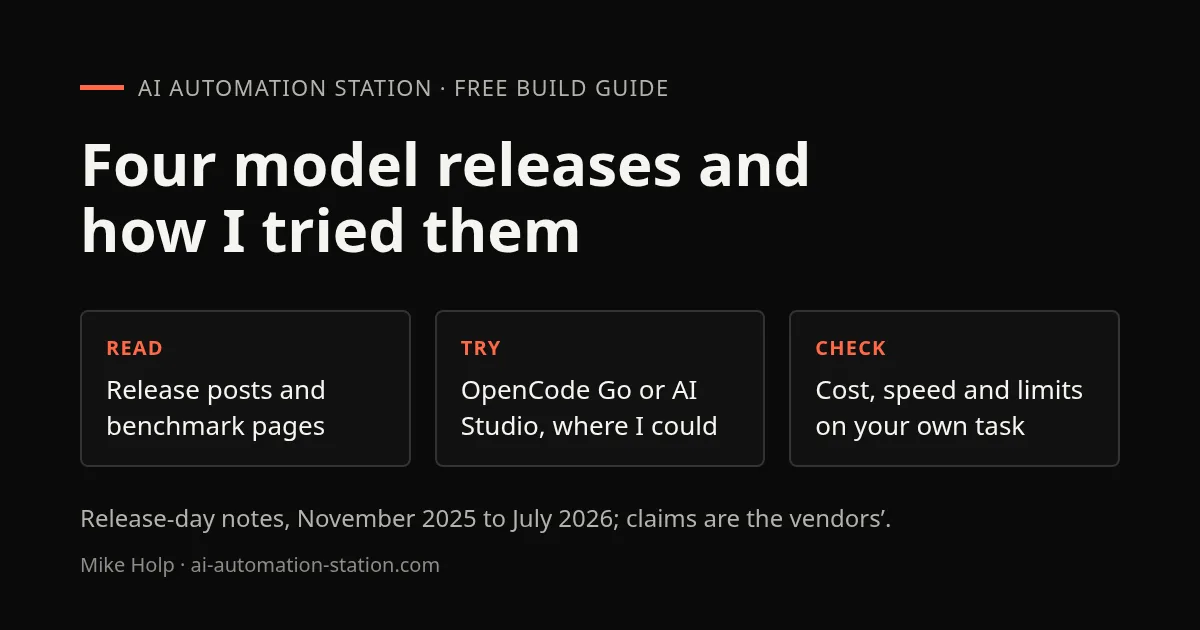
- Release posts and benchmark pages
- OpenCode Go or AI Studio, where I could
- Cost, speed and limits on your own task
What I didn't cover
- My own repeatable benchmark of any of these models. Most comparisons were from others.
- Current prices, limits and availability. They changed quickly.
- Whether the audit and rebuild results hold on other projects.
Watch the walkthrough

- 0:00 Introduction to GLM 5.2 from Z.AI
- 0:19 Benchmarks vs. Claude Opus and Claude Fable
- 1:14 GLM 5.2 parameters, context window, and running locally
- 1:46 Accessing GLM 5.2 directly inside Open Code
- 3:06 Accessing the model through the free desktop app
- 3:26 Coding UI Demos: GLM 5.2 vs. Opus 4.8
- 4:32 Cost, speed, and token efficiency comparison
- 6:21 Bridgebench test ranking results (Reasoning & BS meter)
- 7:24 Token pricing data and model popularity on Open Code Go
- 10:09 Wrap up, Open Code sign-up info, and community invitation
From the video
Lines from the video's transcript that this guide does not cover, lightly trimmed. Each time opens the video at that point. Read the full transcript.
FAQ
How do I try GLM 5.2 or Kimi K3?
In OpenCode on the Go plan, run the models command and select it. Availability and limits depend on the provider.
Did you verify the benchmarks?
No. They come from vendor posts, leaderboards and other creators.
Which model should I use?
Test two or three on a task of your own and compare cost, time and quality.
Sources
- Videos: Is GLM 5.2 The Best Opensource Model Ever?, I Tested Kimi K3 So You Don’t Have To, Claude Fable 5 Is Back: What Changed? and Gemini 3 Outperforming ChatGPT? Here’s What I Found!
- OpenCode through my affiliate link: OpenCode · Google AI Studio: aistudio.google.com
Build the next one with AI Income Lab
Step-by-step courses, reusable templates, and a community that answers when you get stuck.
Members get the Claude Code & Skills and Codex Tutorials & Courses lessons.
- Courses for builds like this one
- Copy-ready templates
- Ask questions while you build
- Weekly coaching on VIP


