GPT-6 Sol and Luna: pricing, benchmarks and availability
Watch on YouTube ↗ Subscribe on YouTube ↗
A walkthrough of OpenAI's announcement of GPT-6 Sol and GPT-6 Luna on September 23, 2026. Sol is priced at $2 per million input tokens, half its predecessor, and Luna at 10 cents. Mike reads OpenAI's own benchmark charts against Opus 5 and Fable 5.1 and says Sol used 2 percent of a weekly limit. Benchmark and price figures are from the announcement and were not tested here.
Video summary
GPT-6 Sol tutorial overview — what changed on price, coding scores, and when to pick Sol vs Luna vs Astra.
The video covers 10 parts: Announcement of the new GPT-6 Soul and GPT-6 Luna model releases., Overview of GPT-6 Soul's capabilities for complex coding and professional work., Overview of GPT-6 Luna's capabilities for fast, efficient, and high-volume everyday work., First-hand experience using GPT-6 Soul in the terminal and its improved usage limits., Breakdown of the updated input and output token pricing for the new models., Viewing a 3D rocket launch demo created with Higgsfield to compare the models side-by-side., Analyzing benchmarks for professional work tasks, comparing GPT-6 Soul to Claude Opus 5., Reviewing coding test results and comparing GPT-6 Soul to Fable 5.1 on Frontier Code., Evaluating computer use performance and how it compares to the reigning GPT-6 Astra., and Details about the creator's Skool community and the video's conclusion..
What this video covers
What you build
Nothing is built. The video summarizes the release, prices, benchmarks and availability of two new models.
Tools used
Key steps
- 0:13 - Hear that Sol targets complex coding and professional work and Luna targets fast, high-volume work.
- 1:21 - Hear Mike's early use of Sol in the terminal and the lower weekly limit use.
- 2:13 - Read the halved input and output token prices for both models.
- 3:58 - Review professional work benchmarks against Claude Opus 5.
- 5:37 - Review coding benchmarks against Fable 5.1 on Frontier Code.
- 7:25 - Review computer use scores, where Astra still leads.
Not covered
- Independent tests. The benchmark charts come from OpenAI's announcement.
- Side-by-side coding results on Mike's own projects.
- Long-term limits or price changes after the launch date.
- A comparison with the competing models beyond the charts shown.
In this video
- 0:00 Announcement of the new GPT-6 Soul and GPT-6 Luna model releases.
- 0:13 Overview of GPT-6 Soul's capabilities for complex coding and professional work.
- 0:26 Overview of GPT-6 Luna's capabilities for fast, efficient, and high-volume everyday work.
- 1:21 First-hand experience using GPT-6 Soul in the terminal and its improved usage limits.
- 2:13 Breakdown of the updated input and output token pricing for the new models.
- 2:44 Viewing a 3D rocket launch demo created with Higgsfield to compare the models side-by-side.
- 3:58 Analyzing benchmarks for professional work tasks, comparing GPT-6 Soul to Claude Opus 5.
- 5:37 Reviewing coding test results and comparing GPT-6 Soul to Fable 5.1 on Frontier Code.
- 7:25 Evaluating computer use performance and how it compares to the reigning GPT-6 Astra.
- 11:10 Details about the creator's Skool community and the video's conclusion.
Questions and answers
What does Sol cost?
$2 per million input tokens, cut from $4, with output prices also halved, per the announcement shown. Luna is 10 cents per million input tokens and 50 cents for output.
Where are the models available?
In ChatGPT and Codex for paid plans from September 23, 2026, and Luna in the desktop app for free users, according to the video.
Is Sol better than Astra?
Astra still leads on computer use at 73 percent against Sol's 64 percent, Mike says, but Sol is about five times cheaper.
Keep learning
Transcript
Well, it's official. We now have a new model release, two new model releases in fact, coming out of Open AI. I've got the official tweet pulled up for it here. They've just announced today the release of GPT6 Soul and GPT6 Luna, which they've added to the GPT6 Universe. Soul is really good at complex coding and professional work at a lower cost. It's roughly five times cheaper than GPT6 Astra. And GPT6 Luna is really good at fast and efficient everyday work at scale.
That one's only 10 cents per million input tokens and 50 cents per million output tokens. It's a very capable model. I've really enjoyed using GPT 5.6 Luna over the past few months. I've got another tweet pulled up over here which was just released about an hour ago. It says the GPT6 family now includes Solo for complex professional workflows and Luna for high volume efficiency.
Read the rest of the transcript
Both building on the recent Astro model with better alignment, factuality, and computer use, they run twice as fast and cheap as GPT 5.6 equivalents with API prices like $2 per million input tokens for Soul and only 10 cents for Luna per million input tokens. They're now available for paid ChatGpt and API users. I've already been using GPT6 soul over here inside the terminal and pretty extensively and I've only used 2% of my weekly usage limit which seems like a significant improvement versus some of the prior
testing that I've been doing. This is the official website for GPT6 Soul and Luna. And it's kind of cool the animation so you can just click and drag to spin around. That's pretty neat. And we can just go ahead and read through this a bit more in detail. So earlier this month they introduced GPT6 Astra, the most intelligent and aligned model in the world. Astra introduced a new generation of intelligence. These models help distribute the benefits of that intelligence by advancing the frontier on cost efficiency.
The GPT6 models lead across the cost intelligence curve, combining exceptional capabilities at every tier with infrastructure that delivers them efficiently at scale. So, we can take a look at the pricing for both of the models here for 5.6 sold that it was $4 per million input tokens and now it's essentially cut in half to $2 per million input tokens. Uh, we've also got the output tokens have essentially been cut in half as well for GPT6 Soul. It's 50% cheaper.
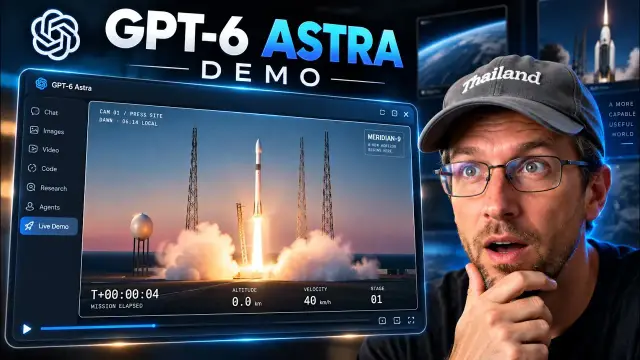
And the exact same thing for GPT6 Luna as well. They've cut the input tokens and output tokens in half. So they're now 50% cheaper. We can also take a look at one of the demos which was created with Higsfield over here showing all of them side by side. So this is a 3D rocket launch all made with Higsfield. And overall I'd say this is pretty impressive. GPT6 Soul looks really good. Astra obviously looking fantastic.
But you have to keep in mind that it is a lot more tokenheavy and considerably more expensive. you can burn through your credits really, really quickly on Astra, which is one of the reasons why I think a lot of people are going to be very excited about this new Soul and Luna release. And I'm already running it over here in the terminal. As you can see, we're now on GPT6 Soul on medium effort mode, and my credits just reset. I've only used 2%.
Overall, that's pretty impressive. And I just got another credit usage reset thanks to OpenAI. they they're very generous with their credit usage resets. Uh whereas with Claude, I still haven't gotten one yet. Even though they just announced Opus 5.5, I can't actually use it yet because I've run out of credits. So, this is one of the reasons why I really, really like ChatGpt for all of my coding tasks. And we can take a look at some of the benchmarks over here for professional work.
GPT6 Soul can take on difficult work tasks while giving you more room to iterate with higher usage limits and lower cost. And this offers more intelligence and better results versus similarly priced competitor models such as Opus 5. So we can see over here Opus 5 right here. It is considerably more expensive, even more expensive than GPT6 Astra on max mode compared to low mode for Claude Opus 5. And now we can also see GPT 5.6 Soul compared to GPT6 soul over here.
So, it is quite a bit cheaper and it's also scoring higher on this particular benchmark which is automation bench. And then same thing for Luna over here. It's scoring higher and it's also considerably cheaper while scoring higher on automation bench. I've also got some benchmarks for agents last exam which evaluates agents on complex professional workflows. GPT6 soul at max effort scores 56.4. four above Claude Opus 5's highest score in the valuation at 60% lower cost per task.
So we'll come on down here and you can see GPT6 Soul coming in at only $2.93 with a score of 56% on agents last exam compared to Opus 5 which is you know considerably more expensive. It's like roughly five times more expensive and it's actually scoring lower, especially on max mode. And then obviously we've got the coding tests over here. This year coding agents have begun tackling tasks with more complexity, scope, and duration than ever before. At OpenAI, the internal usage has grown exponentially.
on Frontier Code, which evaluates whether coding agents produce changes ready to merge into real code bases. GPT6 Soul improves substantially over 5.6 Soul and is able to match Fable 5.1 on extra high mode at much lower cost. So, we can also see over here GPT6 Soul uh 40, let's see, max mode. I'm going to check max mode. Uh, it's it's only costing $2.14 per task with a score of 49% on Frontier Code.
We can compare that to Fable 5.1, which is $12 per cost per task with a score of roughly 50. So, it's roughly scoring about the same, but it's about six times more expensive and roughly the same for Opus 5. It's also it's about nine times more expensive and it's scoring five percentage points lower than uh GPT6 soul on extra high mode. So that's pretty interesting. We've also got another benchmark here uh deepsw s which tests performance on complex software engineering tasks in real code bases.
GPT6 soul at max effort scores 68%. Uh they're all pretty much grouped pretty closely together here, but we can see GPT6 soul on max mode is costing $646 uh with a score of 72.7 and that's considerably cheaper. Once again, three times cheaper versus Fable 5, which is pretty impressive. also with computer use. Uh GPT6 Astra obviously remains the world's best model for computer use and but GPT6 Soul and Luna offer more costefficient performance than their predecessors. So this is definitely good news.
You can use computer use and chances are it's going to be very fast and cheap and efficient. But still, you know, GPT6 Astra is reigning supreme on this one. The score is 73% versus only 64% for GPT6 sole. But if you're using computer use, I would highly recommend just using Astra because it's very fast and efficient. They've improved prompt caching for GPT6.
This is definitely good news to deliver higher cash hits rates by default, helping agents reuse more context, respond faster, and benefit from discounts of 90% on cached input token reads. You can also use something like uh RTK, which I've already made tutorials about on this channel, to save an additional uh tokens. So, I've currently saved 665 million input tokens. That's at roughly 95% token efficiency. So, I would highly recommend installing something like RTK to improve your token efficiency.
But it sounds like they've built in a lot of that caching now directly into GPT6 which is definitely good news. Uh we can take a look at some of the other benchmarks over here for coding deception. So overall they're all very very good in terms of coding deception, broken search, the failure to disclose a broken search tool. GPT 5.6 soil was very high. it was 77.5 whereas GPT6 soul is only 4.9% compared to GPT6 Astra which is obviously their most capable model that's only 1.5%.
And we can see 5.6 Luna versus uh GPT6 Luna is also a very very large improvement there. If we click to view the benchmarks on open router we can see some of the top models over here. GPT6 soil was just announced today. So on max mode is currently ranking number seven in the benchmarks for the intelligence index score and it's coming in right about here.
So you can see it's not scoring as high as Fable 5.1 because it's, you know, GPT6 Astra is right neck to neck with Claude Fable 5.1 and it's slightly more expensive. Whereas GPT6 Soul $1.92, this is only 46. So it's roughly, you know, five times cheaper than GPT6 Astra. And same for Fable 5.1. They're now available in CHBT work and codec starting today. Currently September 23rd for all plus pro business enterprise and edu users.
Free and go users can also access GPT6 Luna in the desktop app. And these models are not yet available in chat but they hopefully will be soon. This is the API. We can see uh GPT6 soul. If we want to learn any more about it, we can come over here to OpenAI developers. You can see where it's scoring on reasoning, speed, as well as the price, input, and output tokens. And it says here it's built for complex coding and agentic workflows.
The context window is a million. And we can see the pricing over here again is $2 per million input tokens for GPT6 soil and 10 cents per million input tokens for GPT6 Luna. And as usual, please go ahead and check out my Skool community. We've currently got 3,000 members inside here. I help you build your first useful AI workflow in 30 days. Prices start at $29 per month and go up to $89 per month for the VIP plan.
Would love to see you inside the Skool community. You can read everything there is to know about it over here on the landing page. And with that being said, thanks so much for watching this video. Please subscribe to the channel. Take care. Stay safe. Peace from Thailand. Signing off. We'll see you in the next one.