Runable AI Audit-Service Website: Research to an MVP
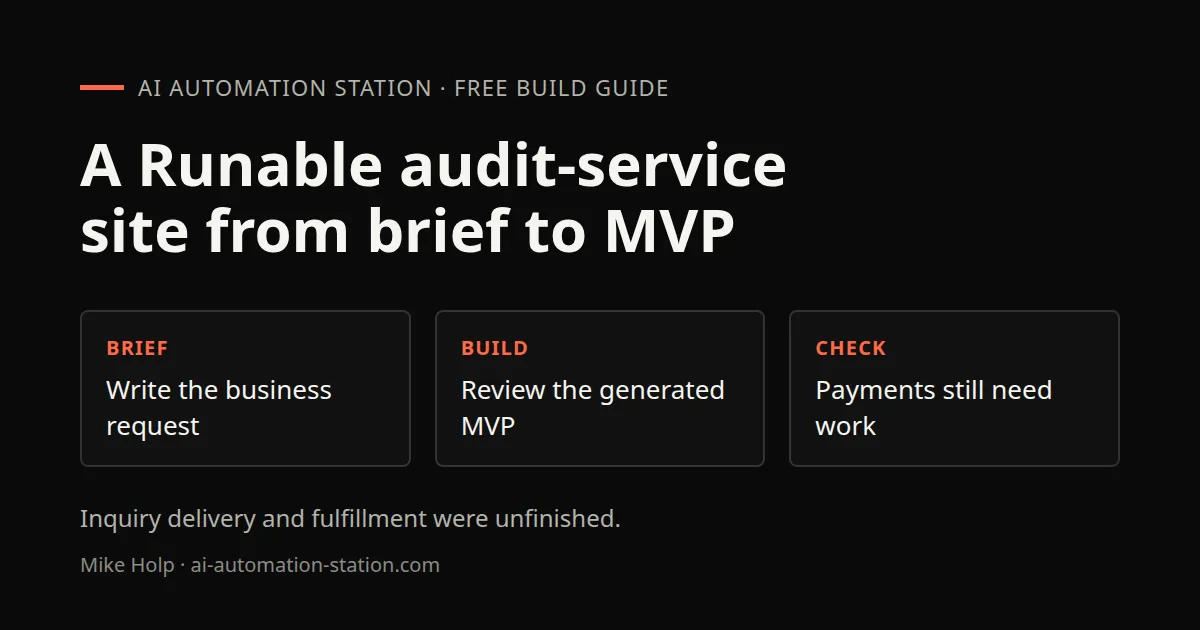
Quick answer: Write the business brief first, then review the generated MVP. The recording reaches a more focused homepage but does not finish Stripe or inquiry-email delivery. A complete-looking site is not a payment-ready business.
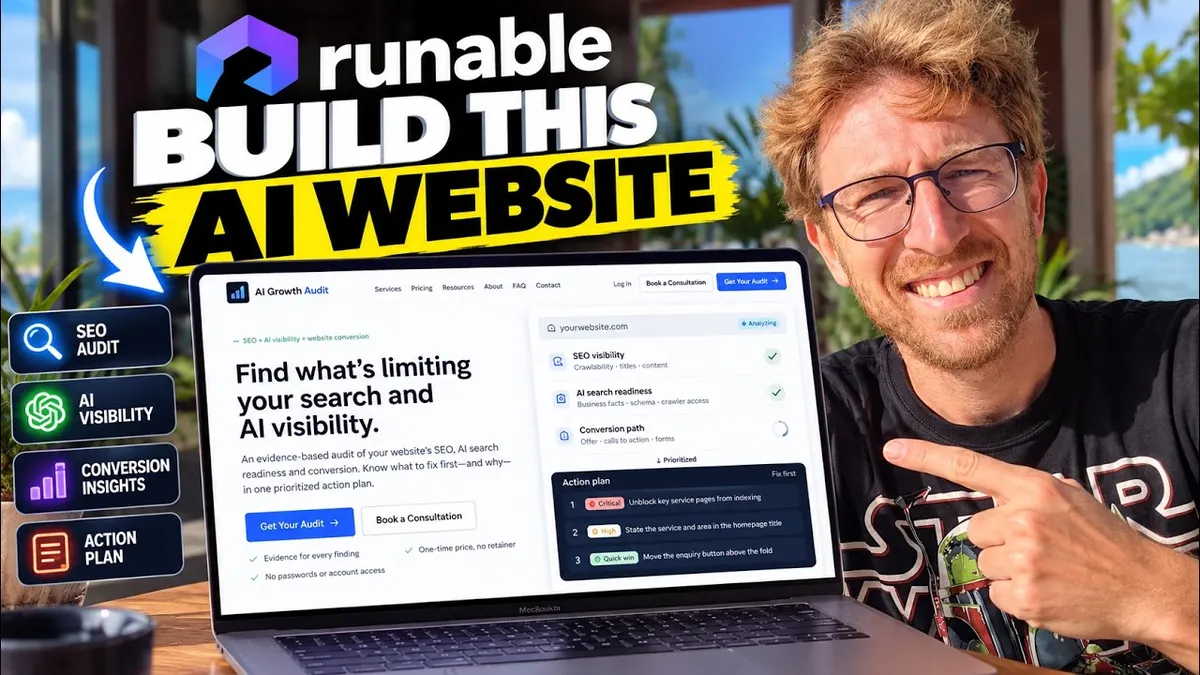
The AAS Runable course follows a service idea called AI Growth Audit. It moves from a business brief through research, an initial website and a more focused homepage. It does not finish a payment-ready online business. Stripe and inquiry-email integration remain unfinished at the end of the spoken source.
That distinction makes the recording useful. A first website can look complete while the transaction and fulfillment systems behind it are still missing.
Write the business brief before the page prompt
Mike defines six parts of the master brief: audience, problem, offer, key promise, conversion goal and design direction. He also excludes invented testimonials and unsupported statistics. That gives later revisions one source of truth instead of a succession of unrelated design requests.
For your own project, decide what a customer actually receives and what action the page should invite. A request for an audit is not the same as a claim that an automated audit already works. Keep missing operational details visible.
Research the offer, then inspect the evidence
The recording uses a detailed market-research prompt in Runable. The result includes research files, competitor information, pricing analysis and an opportunity map. Mike reads parts of those outputs before building.
Research generated by an agent still needs checking. The video’s competitor prices and proposed audit prices are recording-specific material, not current market facts or a pricing recommendation for your business. Inspect the original cited pages before using any number in your own offer.
Keep a template detour from replacing the brief
Runable offers a research-oriented website or customer-facing marketing site, then template options. Mike starts exploring that route but returns to the previously prepared master prompt and research.
The lesson is not that templates are wrong. It is that a template should support the offer rather than silently redefine it. State which material is authoritative when you combine research, attachments and design references.
Generate a first version and read its launch checklist
The resulting MVP has a homepage, customer-portal elements, a chat interface and a consultation path. Mike says the Google sign-in is working in his preview. The generated owner configuration and launch checklist explicitly identify payments as not implemented.
Inspect both the visible site and the configuration report. Test a form’s actual destination rather than assuming that a “Send inquiry” button sends email. Likewise, a chat panel does not prove that the promised paid service can be delivered.
Refine one commercial decision at a time
Mike’s follow-up prompt asks for a clearer hero, a stronger primary audit CTA, less repetitive copy, better hierarchy and transparent scope. It explicitly says not to invent proof. The next version makes the consultation secondary and reduces decorative elements.
This is a repeatable editing pattern: point to the affected section, state the outcome and name what must remain unchanged. “Make it better” gives the agent too much room to change the offer.
Define what is still unfinished
Before a real launch, payments, inquiry delivery, access control and actual service fulfillment need separate checks. Those are editorial launch criteria, not steps completed in the recording. No purchases, live launches or customer tests were performed for this article.
The official Runable site describes website and agent workflows. Its broad business-growth messaging should not be substituted for evidence that this particular MVP is ready to accept orders.
Watch the walkthrough
FAQ
Did Runable build an entire functioning business in this recording?
No. It produced and refined an MVP, with important integrations left for later modules.
Should I copy the recorded audit prices?
No. They came from generated research and a specific business example. Verify your own costs, market and deliverables.
You may also like
Build the next one with AI Income Lab
Step-by-step courses, reusable templates, and a community that answers when you get stuck.
Members get the Claude Code & Skills and Codex Tutorials & Courses lessons.
- Courses for builds like this one
- Copy-ready templates
- Ask questions while you build
- Weekly coaching on VIP


